


By Johnson Lo | Chief Analyst
May 13, 2026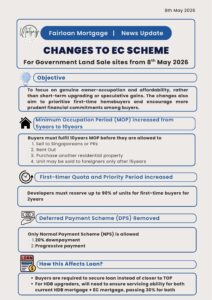
The Singapore EC scheme changes announced on 8 May 2026 mark one of the most significant resets to the Executive Condominium market in recent years. For buyers, the changes go far beyond technical eligibility adjustments. They affect affordability, mortgage planning, upgrading timelines, resale expectations, developer behaviour and the long-term attractiveness of ECs compared with private condominiums.
Executive Condominiums were originally introduced to serve the sandwiched class in Singapore. These are households who earn too much to comfortably qualify for certain public housing options, yet still find private condominiums financially challenging. Over time, however, ECs gradually evolved beyond their original purpose. They became one of the most popular wealth progression tools in Singapore’s property market, particularly among HDB upgraders seeking a lower entry pathway into private style housing with strong capital appreciation potential.
The latest policy changes suggest that the government intends to steer ECs back towards their original purpose as owner-occupied housing for genuine long-term stayers rather than medium-term investment assets. The direction is now very clear. Buyers who enter the EC market moving forward must increasingly view the purchase as a long-term housing commitment rather than a short-term asset progression strategy.
What Are the New EC Scheme Changes Announced on 8 May 2026?
The key changes announced include:
- Minimum Occupation Period increased from 5 years to 10 years
- Full privatisation extended from 10 years to 15 years
- Deferred Payment Scheme removed
- First timer allocation increased from 70 percent to 90 percent
- First timer priority period extended from one month to two years
These changes apply to future EC projects whose Government Land Sale tenders close on or after 8 May 2026.
Why Did the Government Tighten the EC Scheme?
The tightening of the EC scheme ultimately reflects growing concerns over affordability and speculative behaviour within the market.
Over the past decade, EC prices climbed rapidly alongside rising land costs and strong upgrader demand. Many buyers no longer viewed ECs purely as homes. Instead, ECs increasingly became part of a carefully planned wealth accumulation strategy. Buyers entered projects with the expectation that after fulfilling the five year Minimum Occupation Period, they could potentially sell the unit at a substantial profit due to the subsidised entry pricing compared with private condominiums.
As this mindset became more widespread, EC launch prices also rose sharply. Developers became increasingly aggressive in land bids because demand remained consistently strong, especially from second-timer buyers with substantial CPF balances and cash proceeds from previous property sales. Over time, younger first-time households found themselves facing greater affordability pressure and lower success rates during EC launches.
The government’s latest intervention therefore appears aimed at cooling speculative demand, improving accessibility for first-time households and reinforcing the long-term owner-occupied nature of Executive Condominiums.
EC Minimum Occupation Period (MOP) Increased to 10 Years
The most impactful change is undoubtedly the extension of the Minimum Occupation Period from five years to ten years.
Previously, EC owners could sell their units on the open market after fulfilling the five year MOP. Under the revised rules, buyers must now wait ten years before they are allowed to sell the property, rent out the entire unit or purchase another residential property.
In addition, full privatisation will only occur after fifteen years instead of the previous ten year timeline. This means the property can only be sold to foreigners after the fifteenth year.
This single policy adjustment fundamentally changes the financial and psychological structure of EC ownership.
Why Was the MOP Increased?
The government’s objective is relatively straightforward. It wants to reduce flipping activity and encourage genuine long-term occupation.
For many years, a significant proportion of EC owners sold their units shortly after the five year MOP was fulfilled. This indicated that many buyers were entering the EC market primarily because of its capital appreciation potential rather than because they intended to remain in the property long term.
By increasing the MOP to ten years, the government has effectively reduced the attractiveness of ECs as medium-term investment vehicles. Buyers now need to think far more carefully about whether the property genuinely suits their long-term lifestyle and financial needs.
This also changes the entire timeline of ownership. Depending on who the next buyer is, owners may only be able to sell after 15 years from the TOP or key collection date. That is a major shift compared with the previous structure.
What the Longer MOP Means for Buyers
The longer holding period has significant implications for buyers and their financial planning.
Under the previous framework, many households entered EC projects with a relatively clear exit strategy shortly after MOP. The ten years requirement now means buyers must think more conservatively and more realistically about their future financial situation.
A ten years horizon introduces far more uncertainty into a household’s financial planning. Career changes, economic downturns, business volatility, childbirth, ageing parents and educational expenses all become more relevant over such a long period.
As a result, buyers can no longer rely on short-term capital appreciation expectations to justify aggressive borrowing. Instead, the emphasis shifts towards repayment sustainability and long-term affordability.
This is one of the biggest psychological changes resulting from the new EC framework.
How the New EC Rules Affect HDB Upgraders and Loan Eligibility
The latest EC changes will likely have the biggest impact on HDB upgraders, especially in terms of loan affordability and monthly cash flow management.
Previously, many buyers relied on the Deferred Payment Scheme to delay servicing their EC loan during construction while continuing to stay in their existing HDB flat. This helped reduce short-term financial pressure and allowed buyers to manage the transition more comfortably.
With the removal of the Deferred Payment Scheme, buyers must now begin servicing the EC loan progressively during construction itself. As a result, many HDB upgraders may need to concurrently service both their existing HDB loan and the new EC loan before the EC is completed.
This significantly increases monthly financial commitments and may reduce the effective loan amount buyers can comfortably take on. Although buyers are still assessed under the Mortgage Servicing Ratio framework, the practical cash flow burden becomes much tighter due to overlapping housing repayments.
The situation becomes even more challenging because EC buyers remain subject to the income ceiling of $16,000. Unlike private property buyers who may offset higher prices with higher income levels, EC buyers operate within a capped income structure while facing rising property prices and higher financing obligations.
As a result, the latest changes may naturally reduce aggressive upgrading behaviour and encourage buyers to adopt more conservative and sustainable loan commitments.
Deferred Payment Scheme (DPS) Removed
Another major change is the removal of the Deferred Payment Scheme.
Under the previous DPS structure, buyers generally paid a portion of the purchase price upfront while deferring the remaining loan obligations until Temporary Occupation Permit was obtained. This arrangement was extremely attractive to HDB upgraders because it reduced short-term financial pressure during the construction period or having the option to do up a structured bridging loan to pay for the downpayment of the EC.
Without DPS, buyers must now follow the standard progressive payment structure, where mortgage repayments begin progressively during construction itself, therefore this acts as an indirect cooling measure because it naturally filters out highly leveraged purchases.
Will Private Condominiums Become More Attractive?
Interestingly, the new EC framework may unintentionally increase the relative attractiveness of certain private condominiums.
Previously, ECs offered a highly compelling value proposition because buyers could enjoy lower entry prices, condominium facilities and relatively strong capital appreciation potential while benefiting from deferred payment flexibility.
With the removal of DPS, the longer MOP and delayed privatisation timeline, some higher-income buyers may begin questioning whether the restrictions attached to EC ownership remain worthwhile.
For buyers with stronger financial capacity, a private condominium may now appear more appealing because it offers immediate flexibility without occupancy restrictions or delayed resale opportunities.
This may particularly affect buyers comparing ECs with Outside Central Region private condominiums, where the pricing gap has narrowed over recent years.
First-Timer Allocation Increased to 90%
The increase in first-timer allocation from 70 percent to 90 percent represents another major shift in policy direction.
The government is clearly attempting to restore EC accessibility for younger first-time households. Over recent years, second-time buyers increasingly dominated EC launches because they possessed stronger financial resources from previous property ownership.
This often placed younger households at a disadvantage during balloting exercises.
By increasing the first-time allocation substantially, the government hopes to rebalance the market and improve accessibility for genuine first-time homebuyers.
First-Timer Priority Extended to Two Years
Extending the first-timer priority period from one month to two years further reinforces this objective.
This significantly reduces competitive pressure from second-timer households during the initial launch phases of future EC projects.
The policy direction is now very clear. ECs are increasingly being repositioned as housing primarily for first-time owner-occupiers rather than for wealthier upgrader households pursuing another stage of asset progression.
Will EC Prices Drop After the New Rule Changes?
This is naturally the question most buyers are asking.
The realistic answer is that EC prices may moderate, but a sharp collapse remains unlikely.
There are still strong underlying factors supporting the EC market. Land remains limited, construction costs remain elevated and ECs still offer a pricing advantage relative to comparable private condominiums.
However, the new measures clearly weaken several demand drivers that previously fuelled aggressive price growth. The removal of DPS reduces leverage. The longer MOP reduces speculative appeal. The reduced participation of second-time buyers weakens purchasing power within the market.
Collectively, these factors are likely to moderate future price growth rather than trigger an outright decline.
Why Future EC Launch Prices Could Become More Controlled
The latest changes may also significantly influence developer behaviour.
Developers previously bid aggressively for EC land partly because demand from HDB upgraders and second-timer buyers remained extremely strong. This allowed developers to launch projects confidently at increasingly higher price points.
Moving forward, developers may become more cautious because the effective buyer pool has narrowed and grown more financially conservative.
If land bids soften over time, future EC launch pricing could be more restrained than the rapid increases observed in recent years.
This may ultimately improve long-term affordability within the EC market.
Why Existing EC Projects May Become More Attractive
An interesting side effect of the new policy changes is that existing EC projects launched before the rule changes may suddenly become much more attractive.
These projects still enjoy the old framework, including the five-year MOP and earlier privatisation timeline.
As a result, buyers who still prefer the traditional EC asset progression model may increasingly gravitate towards these unaffected projects before the new rules fully take effect.
This could temporarily support demand and pricing for current EC launches and recently launched projects.
What the New Rules Mean for First-Timer Buyers
For first-time households, the changes are generally positive from an accessibility perspective.
Younger families now face less competition from financially stronger second-timer buyers and enjoy significantly greater access to allocations during launches.
However, buyers must still remain financially prudent because the removal of DPS and the longer MOP create greater long-term financial commitments.
Buying an EC now requires a much stronger focus on long-term affordability rather than short-term upgrading ambitions.
What the New Rules Mean for Second Timers
Second-time buyers are likely to face the greatest challenges under the revised framework.
Their allocation access has been reduced substantially, while the overall attractiveness of ECs as medium-term investment assets has weakened considerably.
As a result, many second-timer buyers may increasingly redirect their attention towards resale ECs, resale condominiums or private new launches where flexibility remains higher.
This could gradually redistribute demand across other segments of the Singapore property market.
Final Thoughts
The Singapore EC scheme changes announced in 2026 fundamentally reshape the structure of the Executive Condominium market.
For many years, ECs occupied a unique position within Singapore’s housing landscape by combining subsidised entry pricing with relatively strong investment upside. The latest measures significantly reduce that investment appeal while reinforcing the long-term owner-occupied nature of ECs.
For buyers, this means mortgage planning, affordability management and long-term financial stability become more important than ever before. Buyers can no longer rely on short-term resale opportunities or rapid asset progression expectations to justify aggressive purchases.
At the same time, the changes may gradually restore accessibility for younger first-time households while reducing excessive speculative demand within the EC market.
The likely outcome is not a collapse in EC prices, but rather a more disciplined, more stable, and more owner-occupier-focused market. Buyers who genuinely intend to stay long term may still find ECs highly attractive. However, buyers hoping for quick gains and short holding periods will likely need to rethink their strategy entirely.
If you are looking for the lowest rate or need advise on home loan, do reach out to us.



These mechanisms allow borrowers to demonstrate additional financial capacity and meet loan eligibility, but their nuances are critical to understand. Here’s your comprehensive guide.

Buyer Stamp Duty and Additional Buyer Stamp Duty form a significant part of property purchase costs in Singapore. Understanding how stamp duties are computed, who pays what, when payment is due, and the risks of improper structuring helps buyers avoid costly mistakes and plan their property purchase more confidently in 2026.