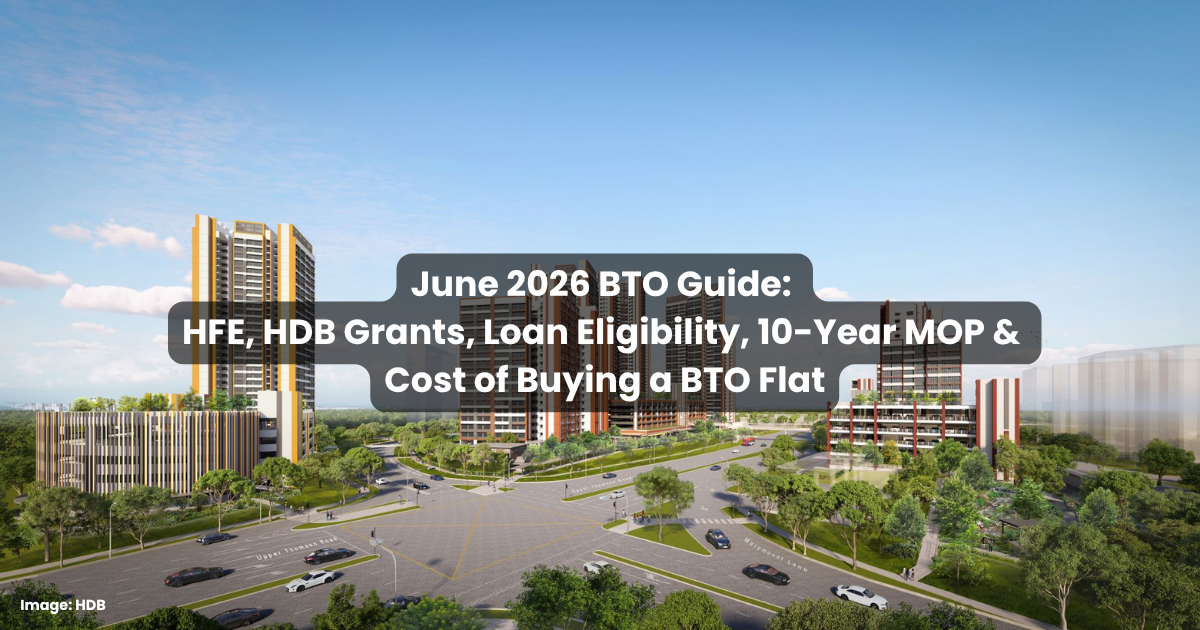
The June 2026 BTO launch is expected to see strong demand once again, particularly with buyers continuing to focus on newer estates, Prime locations, and Plus category flats. However, purchasing a BTO flat today is no longer as straightforward as simply balloting for a unit and waiting for keys.
With the introduction of the HDB Flat Eligibility (HFE) system, tighter financing assessments, new 10-year Minimum Occupation Period (MOP) rules, and rising renovation costs, buyers now need to carefully plan their finances long before the application window opens.
For many Singaporeans, the biggest challenge is no longer whether they can successfully ballot for a flat, but whether they fully understand the actual cost of ownership and the long-term financial commitment involved.
This becomes especially important in 2026, where interest rates remain elevated compared to the ultra-low-rate environment seen a few years ago.
First Step Before Applying for the June 2026 BTO: HFE Letter
Before buyers can apply for any BTO project in the June 2026 launch, they must first obtain a valid HDB Flat Eligibility (HFE) letter.
The HFE has effectively become the foundation of the entire BTO process because it consolidates three major assessments into a single application:
- Eligibility to purchase an HDB flat
- Eligibility for CPF housing grants
- Eligibility and estimated amount for an HDB loan
Without a valid HFE letter, buyers will not be allowed to proceed with a BTO application.
The HFE is generally valid for 9 months, which means applicants planning to participate in the June 2026 BTO exercise should ideally apply by mid May 2026 to avoid delays.
For salaried employees, the process is usually relatively straightforward. However, self-employed individuals, commission-based earners, and freelancers often require additional documentation such as CPF contribution history, Notice of Assessment, and bank statements.
Applicants also need to meet the employment requirements, which generally require continuous employment for at least 12 months while still remaining employed during the HFE assessment period.
Why Buyers Should Also Get a Bank Loan IPA
While the HFE assesses eligibility for an HDB concessionary loan, many buyers today are increasingly exploring bank financing instead due to significantly lower interest rates.
As such, buyers should not rely solely on the HFE.
It is highly advisable to obtain an In-Principle Approval (IPA) from one or multiple banks before the June 2026 BTO launch. This allows buyers to compare financing options early and better understand their affordability.
As of 2026, bank fixed rates for HDB flats are generally ranging between approximately 1.45% to 1.98%, while the HDB concessionary loan remains around 2.6%.
Although this difference may initially appear small, the impact over a 25-year loan can be substantial.
For example, on a $500,000 housing loan, the monthly instalment difference between a 2.6% HDB loan and a 1.60% bank loan can exceed several hundred dollars monthly.
Over time, this could potentially translate into tens of thousands of dollars in interest savings.
HDB Loan vs Bank Loan: Which Is Better in 2026?
For many first-time buyers, deciding between an HDB loan and bank loan remains one of the most important financial decisions throughout the BTO process.
An HDB concessionary loan currently offers greater stability because its interest rate remains pegged at 0.1% above the CPF Ordinary Account interest rate, effective interest rate at 2.6% fixed. This makes repayments more predictable and reduces exposure to short-term market fluctuations.
HDB loans also tend to be slightly more forgiving during financial difficulties and may be easier for certain buyers to qualify for.
However, the main disadvantage is the higher interest rate.
At around 2.6%, HDB loans are currently significantly more expensive compared to many bank fixed-rate packages in 2026.
Bank loans, on the other hand, offer much lower rates at present, with some fixed packages ranging between 1.45% and 1.98%
This can substantially reduce monthly repayments and total interest costs during the lock-in period.
However, buyers should also understand the trade-offs.
Unlike HDB loans, bank loans are subject to market conditions. Once the fixed period ends, interest rates may fluctuate depending on the broader interest rate environment. Buyers who overstretch their affordability based purely on low initial rates may eventually face repayment pressure later.
Ultimately, there is no universally “better” option. The most suitable financing structure depends on the buyer’s risk appetite, income stability, long-term plans, and cash flow comfort.
Understanding the 75% Loan-to-Value (LTV) Limit
One important point many buyers still misunderstand is the current Loan-to-Value (LTV) limit.
As of 2025 and continuing into 2026, both HDB loans and bank loans generally allow buyers to borrow up to 75% of the property price.
This means buyers must prepare the remaining 25% as downpayment.
For HDB loans, 25% of the downpayment can be paid using CPF-OA savings.
For bank loans, however, at least 5% of the property price must be paid in cash.
This becomes particularly important for younger buyers who may have sufficient CPF balances but limited cash reserves.
CPF Grants Available for June 2026 BTO Buyers
One of the biggest financial advantages available to first-time BTO applicants remains CPF housing grants.
Eligible first-timer families may receive up to $80,000 under the Enhanced CPF Housing Grant (EHG), while eligible singles may receive up to $40,000.
The amount granted depends largely on household income, with lower-income households receiving larger grant amounts.
To qualify for the EHG, buyers generally must:
- Be first-time applicants
- Have a household income not exceeding $9,000
- Meet the required employment criteria
- Purchase a flat with sufficient remaining lease
These grants can significantly reduce the overall loan required and lower monthly instalments substantially.
However, buyers often confuse BTO eligibility with grant eligibility.
A household may still qualify to apply for a BTO flat under the broader income ceiling, but exceed the income threshold for CPF grants.
What About Second-Timer Buyers?
Second-timer buyers face a more complex situation.
While they may still apply for selected BTO projects, they generally receive lower ballot priority compared to first-timers. Grant support may also be more limited.
More importantly, many second-timer buyers purchasing another subsidised flat are required to pay a resale levy.
The resale levy is essentially a mechanism to recover part of the subsidy enjoyed from the previous subsidised flat purchase.
Depending on the previous flat type sold, the resale levy can range from approximately $15,000 to $50,000.
For example:
- Previous 3-room flat owners generally pay a $30,000 levy
- Previous 4-room flat owners generally pay a $40,000 levy
- Previous 5-room flat owners generally pay a $45,000 levy
This levy is usually deducted from the proceeds of the existing flat sale.
The New 10-Year MOP Rules Explained
One of the biggest housing policy changes affecting newer BTO projects is the revised MOP framework introduced for Plus and Prime flats.
Traditionally, most HDB flats carried a 5-year Minimum Occupation Period.
However, under the newer framework of MOP:
- Standard flats: 5-year MOP
- Plus flats: 10-year MOP
- Prime flats: 10-year MOP
This means owners of Plus and Prime flats cannot sell their flat or rent out the entire unit for a full decade.
The stricter rules were introduced because these flats generally enjoy greater subsidies and are located in more desirable locations with stronger long-term value potential.
As a result, buyers should no longer view Prime or Plus flats purely as short-term upgrading opportunities.
Instead, they should carefully consider whether they can comfortably remain in the property for a very long period before committing.
The Actual Cost of Buying a BTO Flat in 2026
Many buyers underestimate the total cost involved in purchasing a BTO flat.
Beyond the advertised purchase price, buyers also need to prepare for multiple additional costs throughout the journey.
These include:
- Option fees
- Downpayment
- Buyer’s Stamp Duty
- Legal fees
- Fire insurance
- Renovation costs
- Furniture and appliances
In particular, renovation costs remain significantly elevated in 2026 due to labour shortages and material costs.
For many households, renovation expenses can easily range between $40,000 to $80,000 depending on flat size and design expectations.
This is why proper financial planning remains extremely important before applying for a BTO project.
Estimated Timeline for June 2026 BTO Buyers
The BTO process is often much longer than many first-time buyers expect.
For buyers intending to apply in June 2026, the journey usually begins months before the launch itself through HFE applications and financing preparation.
After the launch period, applicants typically wait for ballot results before proceeding to flat selection and financing confirmation.
Construction timelines generally range between three to five years depending on project complexity and location.
Following key collection, the Minimum Occupation Period officially begins.
For Standard flats, this remains at 5 years, while Plus and Prime flats now require a 10-year occupation period before owners are allowed to sell the property.
Final Thoughts
The June 2026 BTO launch continues to offer valuable opportunities for Singaporeans entering the property market, especially first-time buyers benefiting from CPF grants and subsidised pricing.
However, the BTO landscape today has become far more financially complex compared to previous years.
Understanding the HFE process, comparing bank loans against HDB financing, evaluating grant eligibility, planning for renovation costs, and considering long-term MOP restrictions are now all equally important parts of the decision-making process.
Ultimately, the goal should not simply be securing the largest possible loan or obtaining the most heavily subsidised flat.
Instead, buyers should focus on selecting a property that remains financially sustainable and suitable for their long-term lifestyle and family plans.
Do check out the latest and updated rates as of May 2026.