
- Insights & Updates
Latest News

By Johnson Lo | Chief Analyst
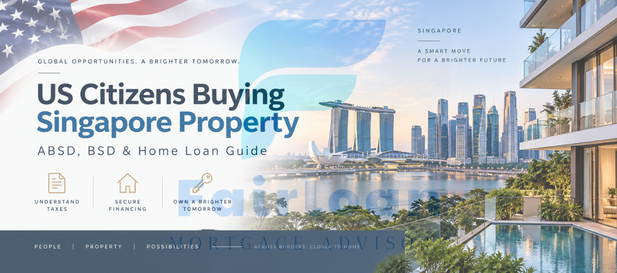
September 15, 2026Singapore remains an attractive destination for international property buyers because of its political stability, strong legal system and established private property market.
However, foreigners purchasing residential property in Singapore are generally subject to significantly different rules from Singapore Citizens, particularly when it comes to Additional Buyer’s Stamp Duty (ABSD).
US citizens are an important exception.
Because of Singapore’s Free Trade Agreement arrangements with the United States, a US national buying residential property in Singapore can receive the same ABSD treatment as a Singapore Citizen.
This can make buying a Singapore property considerably more attractive for Americans compared with most other foreign buyers.
In this guide, we cover:
- BSD and ABSD for US citizens
- Why US citizens may not have to pay the 60% foreigner ABSD
- What properties Americans can buy in Singapore
- Whether US-based income can be recognised for a Singapore mortgage
- Documents that banks may require
- FATCA and Form W-9 requirements
- How FairLoan can assist foreign buyers with their Singapore home loan
1. Do US Citizens Pay ABSD When Buying Property in Singapore?
For most foreigners buying residential property in Singapore, the prevailing ABSD rate is 60%, on top of the normal Buyer’s Stamp Duty.
US citizens are treated differently.
Under Singapore’s Free Trade Agreement-related ABSD remission rules, nationals of the United States are accorded the same stamp duty treatment as Singapore Citizens.
As at 2026, this means:
Singapore residential properties owned | ABSD for US national |
First property | 0% |
Second property | 20% |
Third and subsequent properties | 30% |
This is a major difference compared with the standard 60% ABSD imposed on most foreign buyers for any residential property.
What if you already own property in the United States?
There is another important point that overseas buyers sometimes overlook.
Residential properties located outside Singapore are not included when determining your Singapore residential property count for ABSD purposes.
For example, suppose you are a US citizen who owns:
- a house in California; and
- an apartment in New York.
If you have never owned a residential property in Singapore and purchase your first Singapore condominium, it can still be treated as your first Singapore residential property for ABSD purposes.
Subject to meeting the FTA remission requirements, your ABSD can therefore be 0%.
Does a US Green Card holder qualify?
IRAS specifically lists nationals of the United States of America as qualifying for the FTA treatment. Therefore, simply holding US Permanent Resident status or a Green Card does not by itself provide the same treatment if you are not a US national.
2. Which Other Foreigners Receive Similar ABSD Treatment?
The United States is not the only country covered by Singapore’s FTA-related ABSD remission arrangements.
IRAS currently accords Singapore Citizen-equivalent stamp duty treatment to:
- Nationals and Permanent Residents of Iceland
- Nationals and Permanent Residents of Liechtenstein
- Nationals and Permanent Residents of Norway
- Nationals and Permanent Residents of Switzerland
- Nationals of the United States of America
The precise eligibility conditions differ, so buyers should confirm their status before exercising an Option to Purchase.
3. Buyer’s Stamp Duty for US Citizens
The FTA treatment relates to Additional Buyer’s Stamp Duty.
It does not mean that a US citizen pays no stamp duty at all.
Like other property purchasers, the buyer still has to pay Buyer’s Stamp Duty (BSD).
For residential properties, BSD is calculated progressively on the higher of the property’s purchase price or market value:
Residential property value | BSD rate |
First S$180,000 | 1% |
Next S$180,000 | 2% |
Next S$640,000 | 3% |
Next S$500,000 | 4% |
Next S$1.5 million | 5% |
Amount above S$3 million | 6% |
Example: US citizen buying a S$2 million condo
Assuming this is the buyer’s first residential property in Singapore and the buyer qualifies for US FTA treatment:
Purchase price: S$2,000,000
BSD:
- First S$180,000 × 1% = S$1,800
- Next S$180,000 × 2% = S$3,600
- Next S$640,000 × 3% = S$19,200
- Next S$500,000 × 4% = S$20,000
- Remaining S$500,000 × 5% = S$25,000
Total BSD: S$69,600
ABSD: S$0, assuming the FTA remission applies and this is the buyer’s first Singapore residential property.
For comparison, a foreign buyer who does not qualify for FTA treatment could potentially face 60% ABSD, equivalent to S$1.2 million on a S$2 million property.
This makes nationality an extremely important consideration when planning a foreigner’s Singapore property purchase.
4. What Property Can a US Citizen Buy in Singapore?
US citizens can purchase private property in Singapore, but the rules depend on the type of property.
Private condominium or apartment
A foreign person can purchase a condominium unit or private flat unit without obtaining approval from the Singapore Land Authority under the Residential Property Act.
For this reason, private condominiums make up a significant portion of residential properties considered by foreign buyers.
Landed property
Landed property is considerably more restricted.
Foreign persons who want to purchase properties such as:
- Terrace houses
- Semi-detached houses
- Bungalows
- Detached houses
- Certain strata landed properties
- Landed residential property at Sentosa Cove
must obtain approval from the Singapore Land Authority under the Residential Property Act.
SLA assesses applications individually. Among the factors considered are whether the applicant has been a Singapore Permanent Resident for at least five years and whether the applicant has made an exceptional economic contribution to Singapore.
Therefore, buying a private condominium is generally much more straightforward for a US citizen than purchasing landed property.
HDB flats
A US citizen who is simply a foreigner and neither a Singapore Citizen nor Singapore Permanent Resident cannot purchase an HDB resale flat as an owner in his or her own right.
HDB requires a resale flat buyer to be a Singapore Citizen or Singapore Permanent Resident and to satisfy the relevant household eligibility requirements.
There are separate schemes where, for example, a Singapore Citizen purchases an HDB flat with a non-resident spouse forming part of the household. These should not be confused with a foreign citizen independently purchasing an HDB flat.
Executive Condominiums
Executive Condominiums have additional ownership restrictions during their controlled period.
For many existing ECs, foreigners can purchase after the development has passed its applicable full privatisation period(10years). However, rules have also changed for newer EC sites from 2026, so eligibility should be checked against the particular development’s TOP date and applicable HDB rules before purchasing.
5. Can a US Citizen Obtain a Singapore Home Loan?
Yes.
Foreigners can obtain mortgage financing from Singapore banks for eligible private residential property.
However, being eligible to purchase the property and being eligible for a mortgage are two separate assessments.
The bank will consider matters including:
- Nationality and residency status
- Employment history
- Income
- Income currency
- Existing debts
- Credit history
- Property value
- Loan tenure
- Loan-to-Value requirements
- Total Debt Servicing Ratio
- The bank’s own internal credit policies
The Association of Banks in Singapore notes that housing loan approval remains subject to matters including residency status, regulatory requirements, satisfactory credit repayment history, stable employment or business history and the bank’s own credit requirements.
6. US Income vs Singapore Income: Does It Affect Mortgage Approval?
This is where choosing the right bank becomes particularly important.
If you work in Singapore and are paid in SGD
For example, you may be a US citizen working in Singapore under an Employment Pass and receiving your salary in Singapore dollars.
This is generally the more straightforward profile from a mortgage assessment perspective.
Banks can typically review locally generated documents such as:
- Singapore employment contract
- Payslips
- Salary-crediting bank statements
- IRAS Notice of Assessment, where available
- Employment Pass
- Existing Singapore banking and credit records
Because the income is earned and paid locally in SGD, there is also less foreign-exchange risk for the lender.
As a result, there may be a broader range of Singapore banks available to consider.
If you work in the United States and earn USD
Obtaining financing can still be possible, but the assessment becomes more bank-specific.
Not every Singapore bank assesses overseas income in exactly the same manner. Banks may have different requirements regarding:
- Country of employment
- Employer profile
- Income currency
- Income verification
- Length of employment
- Overseas tax documentation
- Credit checks
- Loan quantum
- Applicant’s assets and banking relationship
DBS, for example, specifically states that additional documents may be required for customers working overseas and asks overseas-income applicants for salary-crediting statements supporting their income.
Therefore, a US citizen earning USD should ideally obtain an In-Principle Approval before committing to a Singapore property purchase.
This allows the buyer to determine:
- Which banks can recognise the income;
- How much of the income will be recognised;
- The estimated maximum loan;
- The required cash downpayment; and
- The available mortgage packages.
7. TDSR for US Citizens Buying Singapore Property
Foreign buyers taking a Singapore property loan will generally still be assessed under Singapore’s Total Debt Servicing Ratio (TDSR) framework.
The prevailing TDSR threshold is 55% of gross monthly income. In simple terms, the borrower’s total monthly debt commitments, including the proposed mortgage, should generally not exceed 55% of recognised gross monthly income.
Banks will also consider existing obligations such as:
- Property loans
- Car loans
- Personal loans
- Student loans
- Credit facilities
- Other debt commitments
Overseas liabilities should therefore be properly declared during the application.
If part of the applicant’s income consists of bonuses, commissions or other variable income, the amount recognised for TDSR purposes may also be subject to a haircut.
8. What Documents Does a US Citizen Need for a Singapore Mortgage?
Exact requirements vary between banks and borrower profiles, but a US citizen should generally be prepared to provide documents covering four broad areas.
Identification
This may include:
- US passport
- Singapore Employment Pass, if applicable
- Proof of residential address
- Tax residency information
Employment and income
For salaried applicants, banks may request:
- Latest employment contract or employer letter
- Recent payslips
- Recent salary-crediting bank statements
- Relevant income tax documents
DBS, for example, publishes requirements including a passport for foreign borrowers, recent payslips and salary-crediting account statements, with additional documentation potentially required for customers working overseas.
Existing financial commitments
The bank may request statements relating to:
- Existing mortgages
- Personal loans
- Car loans
- Credit cards
- Other credit facilities
These are relevant when assessing the borrower’s overall TDSR.
Property documents
Depending on the stage of purchase, these may include:
- Option to Purchase
- Sale & Purchase Agreement
- Property valuation
- Other conveyancing documents
9. Do US Citizens Need W-8BEN or W-9?
US citizens are generally subject to Foreign Account Tax Compliance Act (FATCA) reporting requirements when dealing with financial institutions outside the United States.
Singapore financial institutions are therefore required to identify customers who are US Persons and may have reporting obligations relating to their financial accounts.
W-9
A US citizen may be required to provide Form W-9 or equivalent FATCA/self-certification information confirming his or her status as a US Person and US Taxpayer Identification Number.
W-8BEN
A US citizen would generally not use Form W-8BEN to establish his or her tax status.
The IRS states that Form W-8BEN is used by foreign individuals to establish that they are not US persons. The IRS specifically instructs US citizens, including those living outside the United States, to use Form W-9 instead where applicable.
It is worth noting that these forms relate primarily to tax status and FATCA compliance. They are not themselves documents proving mortgage affordability.
How FairLoan Helps US Citizens and Foreigners Buy Property in Singapore
Navigating a Singapore mortgage as a foreign buyer involves more than simply comparing interest rates.
Different banks can have different credit policies for foreign applicants, overseas employment, foreign-currency income and documentation requirements.
Foreign-income mortgage cases can be more complicated than standard Singapore salaried applications.
For this reason, a US buyer should ideally obtain an In-Principle Approval (IPA) before committing to the purchase.
This is particularly important for buyers earning income outside Singapore, as different banks may assess the same borrower differently.
FairLoan Mortgage Advisory specialises in assisting both Singapore residents and foreign buyers with property financing in Singapore.
Our team consists of experienced ex-bankers with close to 10 years of experience in the Singapore mortgage industry.
For US citizens and other foreign buyers, we can assist with:
- Assessing your estimated borrowing capacity
- Understanding which banks may recognise your income profile
- Comparing mortgage packages across banks
- Applying for an In-Principle Approval
- Reviewing foreign and overseas income
- Structuring the loan application
- Understanding TDSR and Loan-to-Value requirements
- Coordinating the mortgage process from IPA to completion
If you are a US citizen planning to purchase a condominium or private property in Singapore, speak with FairLoan before committing to your purchase.
We can review your income, existing liabilities, residency status and intended property purchase to identify suitable financing options across Singapore banks.
Contact FairLoan Mortgage Advisory for a personalised assessment of your Singapore property financing options.
Information in this article is based on prevailing regulations as at September 2026 and is intended as a general guide. Stamp duty, property eligibility and bank lending policies may change. Buyers should obtain personalised tax, legal and financing advice where appropriate.
Frequently Asked Questions
Can a US citizen buy a condo in Singapore?
Yes. A US citizen can generally purchase a private condominium unit in Singapore without obtaining approval from the Singapore Land Authority under the Residential Property Act.
Does a US citizen pay 60% ABSD in Singapore?
Not necessarily. Qualifying US nationals receive the same ABSD treatment as Singapore Citizens under Singapore’s FTA-related remission rules. This means there is currently no ABSD on the first Singapore residential property, while the second and third/subsequent properties attract 20% and 30% respectively.
Does my house in the United States count as my first property for Singapore ABSD?
No. Residential properties outside Singapore are excluded from the residential property count used for determining Singapore ABSD.
Can a US citizen get a mortgage in Singapore?
Yes, subject to the bank’s credit assessment, TDSR, LTV requirements, income recognition and internal lending policies.
Can Singapore banks recognise my US salary?
Potentially, yes. However, banks differ in how they assess overseas income and the supporting documents they require. Applicants earning US income should obtain an IPA before committing to a property purchase.
Does a US citizen need Form W-8BEN for a Singapore mortgage?
Generally, no. W-8BEN is used to establish that an individual is a foreign, non-US person. A US citizen may instead be required to complete Form W-9 or the bank’s relevant FATCA/self-certification documentation.
Latest Posts
Explore related content by topic
Does HDB Approve Higher Loan Amounts Than Banks? (Fairloan Explains)
HDB often approves higher loan amounts because it uses a lower stress-test rate than banks’ 4%. While both now cap at 75% LTV, HDB loans let you use CPF for the full downpayment, offering stability versus fluctuating bank rates.
What Is an Option to Purchase (OTP) & How to Avoid Losing It in Singapore (2026 Guide)
The Option to Purchase (OTP) is the first legal step in securing an HDB or private property, but many buyers lose their option fee by mistake. This guide explains how HDB and private OTPs work, common reasons for forfeiture, and the essential steps to secure financing and avoid losing your OTP.