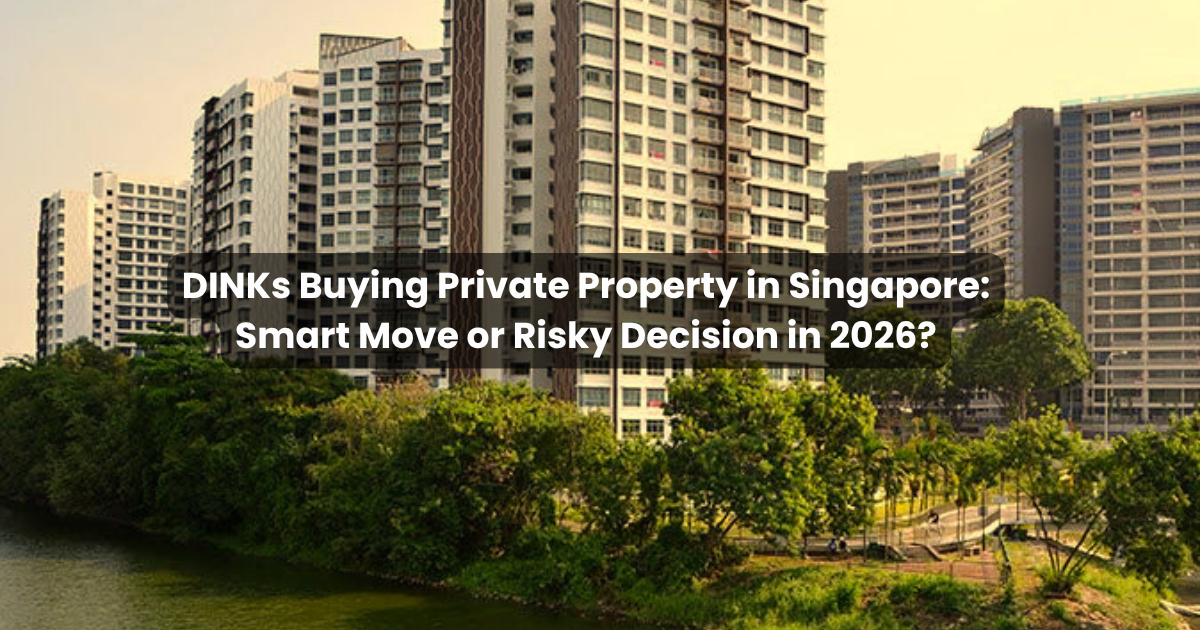
In recent months, there has been growing discussion around DINKs (Dual Income, No Kids) in Singapore entering the private property market. With rising incomes, fewer immediate financial obligations, and greater lifestyle flexibility, many DINK couples are now considering whether to skip HDB entirely and go straight into private property.
At first glance, this seems like a logical move. Two incomes provide stronger affordability, and without childcare expenses, cash flow appears manageable.
However, when it comes to mortgage approval and long-term financial sustainability, the decision is not as straightforward as it seems.
We shall explore whether buying private property as a DINK couple in Singapore is truly a smart financial strategy in 2026, or whether there are hidden risks that buyers should carefully consider.
Who Are DINKs and Why Are They Entering the Property Market?
DINKs refer to couples with Dual incomes, No Kids, typically in their late 20s to early 40s. This group has become increasingly prominent in Singapore, especially among professionals who prioritise career growth, lifestyle, and financial independence.
With combined household incomes often exceeding $10,000 to $20,000 per month, DINKs naturally have stronger purchasing power compared to single buyers or even some young families. Without the immediate financial burden of raising children, they are also able to allocate more funds towards property investment or home ownership.
In 2026, with continued discussions around rising HDB prices and evolving aspirations, many DINK couples are asking a critical question: Should we skip HDB and go straight into private property?
The Appeal of Private Property for DINK Couples
Private property offers several advantages that are particularly attractive to DINK buyers.
Firstly, there is the issue of flexibility. Unlike HDB flats, private properties are not subject to Minimum Occupation Period (MOP) restrictions. This means owners have the freedom to sell or rent out the property at any time, making it more suitable for those who value mobility or are considering investment opportunities.
Secondly, private properties are often perceived as better long-term assets. While this is not always guaranteed, there is a common belief that private property offers stronger capital appreciation potential compared to HDB flats, particularly in well-located developments.
Thirdly, lifestyle plays a role. Condominiums offer facilities such as pools, gyms, and security, which appeal to younger couples seeking convenience and quality of living.
From a purely financial perspective, the combination of two incomes and fewer liabilities makes the entry into private property seem achievable.
However, this is where many buyers begin to oversimplify the situation.
Mortgage Approval: Income Alone Is Not Enough
One of the most common misconceptions among DINK buyers is that a high combined income guarantees mortgage approval.
In reality, banks assess borrowers based on more than just income. Key factors include income stability, credit history, employment consistency, and overall financial profile.
For DINK couples, this means that even with strong combined earnings, approval is not automatic.
Banks will assess:
- Whether both incomes are stable and consistent
- Whether CPF contributions are regular and aligned
- Whether there are existing liabilities such as car loans or credit card balances
- Whether both parties have clean credit records
In some cases, one partner may have a strong financial profile while the other has inconsistencies. This can affect the overall application, particularly if both incomes are required to meet loan eligibility.
This is why many high-income couples are surprised when their loan approval is lower than expected, or in some cases, rejected.
The Role of TDSR and Loan Affordability
In Singapore, mortgage approval is governed by the Total Debt Servicing Ratio (TDSR), which caps total monthly debt obligations at 55% of gross monthly income.
For DINK couples, this can work in their favour, as dual incomes increase the allowable borrowing capacity. However, this does not mean that buyers should maximise their loan.
A key issue arises when couples base their purchase decision purely on maximum loan eligibility rather than comfortable affordability.
For example, a couple earning $15,000 per month may technically qualify for a large loan. However, if interest rates rise or one income is disrupted, the repayment burden can quickly become stressful.
This is particularly relevant in 2026, where interest rates are still subject to global uncertainties and inflationary pressures.
Interest Rate Environment in 2026
The current interest rate environment adds another layer of complexity.
As discussed in recent market trends, fixed rates have increased from around 1.45% to approximately 1.60%, while longer-term fixed packages are becoming less attractive or more expensive. At the same time, floating rates remain relatively low in the short term.
For DINK buyers, this creates a dilemma:
- Lock in higher fixed rates for stability
- Or take floating rates with uncertainty
The risk is that many buyers focus on current affordability without fully considering future rate movements. A property that feels affordable at 1.00% may become significantly more expensive if rates increase over the next few years.
Lifestyle vs Financial Discipline
One of the defining characteristics of DINK couples is lifestyle flexibility. Without children, there is greater freedom to spend on travel, dining, and personal interests.
However, this can also lead to underestimating long-term financial commitments.
A private property purchase is not just about the monthly mortgage. It also includes:
- Maintenance fees
- Property tax
- Insurance
- Renovation costs
These additional expenses can add up, particularly for higher-end developments.
Without careful planning, couples may find themselves in a situation where their lifestyle needs to be adjusted significantly to accommodate the property.
What Happens If Plans Change?
Another important consideration is future life changes.
Many DINK couples may eventually decide to have children, change careers, or reduce working hours. These changes can impact household income and financial priorities.
A property that is affordable under current conditions may become less manageable if circumstances change.
This is why banks place emphasis on income stability rather than just income level. They are effectively stress-testing your ability to repay the loan under less favourable conditions.
Is Skipping HDB the Right Move?
The decision to skip HDB and go straight into private property depends on individual circumstances.
For some couples, particularly those with strong and stable incomes, minimal liabilities, and long-term financial planning, entering the private market early can be a strategic move.
However, for others, HDB may still provide a more balanced approach. It offers:
- Lower entry cost
- Greater financial buffer
- Reduced risk exposure
The key is not to view HDB as a “step down,” but rather as part of a broader property strategy.
A More Strategic Approach for DINK Buyers
Instead of asking whether to buy private property immediately, DINK couples should consider a more structured approach.
This includes evaluating:
- Income stability over the next 3–5 years
- Potential changes in lifestyle or family plans
- Risk tolerance for interest rate fluctuations
- Overall financial goals beyond property
By taking a longer-term perspective, buyers can avoid making decisions based solely on current affordability or market trends.
Final Thoughts
DINK couples are undoubtedly in a strong position within Singapore’s property market. Dual incomes and fewer immediate obligations provide a solid foundation for property ownership.
However, high income does not automatically translate into the right decision.
Buying private property is a long-term commitment that requires careful consideration of financial stability, risk tolerance, and future plans. In 2026, with interest rate uncertainty and evolving market conditions, this becomes even more important.
The decision should not be driven by what is possible, but by what is sustainable.
Why Professional Advisory Matters
Navigating the property market as a DINK couple involves more than just choosing a property, it requires aligning your mortgage, financial goals, and risk profile.
Different banks assess income differently, and loan structures can significantly impact long-term affordability. A well-structured loan can provide flexibility and protection, while a poorly structured one can create unnecessary stress.
As Singapore’s largest mortgage advisory, Fairloan works closely with clients to:
- Assess borrowing capacity accurately
- Compare loan packages across all banks
- Structure financing based on long-term goals
If you are considering entering the private property market, it is always advisable to seek guidance before making a commitment.
Do check out Singapore’s Latest and Lowest Home Loan Rates here.