
- Insights & Updates
Latest News

By Johnson Lo | Chief Analyst
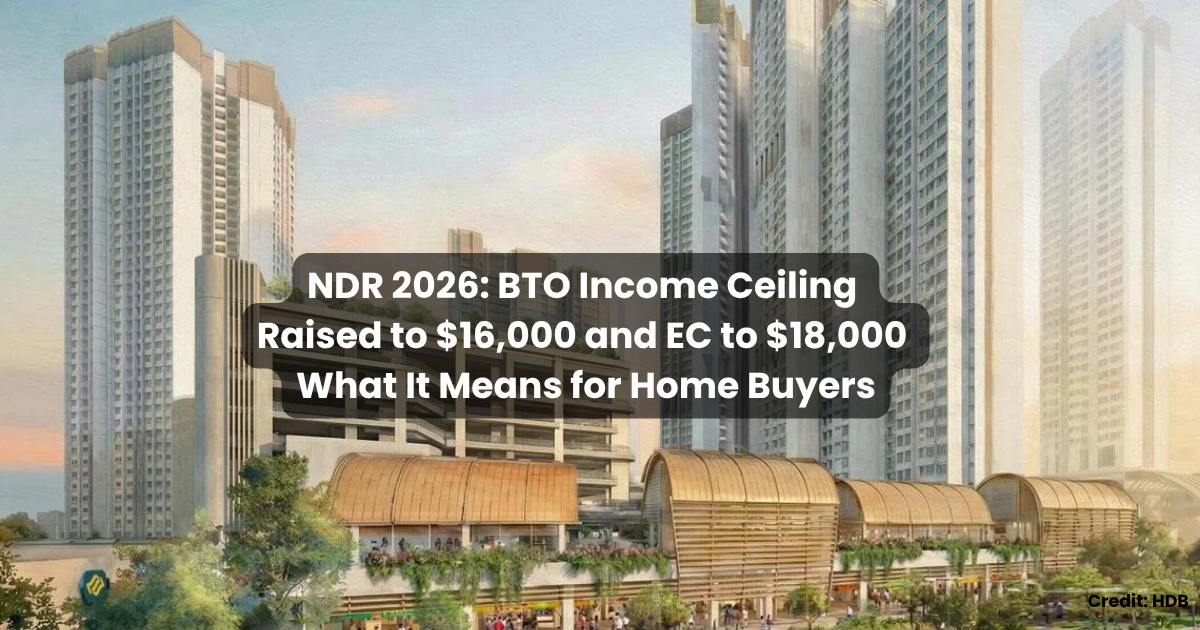
August 27, 2026Singapore’s National Day Rally 2026 brought one of the more significant housing policy changes in recent years: the household income ceiling for subsidised HDB flats has been increased from $14,000 to $16,000 per month, while the income ceiling for new Executive Condominiums (ECs) has been raised from $16,000 to $18,000 per month.
The revised HDB ceiling applies to eligible families applying for an HDB Flat Eligibility (HFE) letter from 24 August 2026. It covers the purchase of new subsidised HDB flats, eligibility for the CPF Housing Grant when purchasing a resale flat, as well as eligibility for an HDB housing loan. For eligible singles aged 35 and above, the corresponding ceiling has increased from $7,000 to $8,000.
For new ECs, there is one important distinction: the new $18,000 ceiling does not automatically apply to existing EC projects. It applies to new EC units arising from sites where the land tender closes on or after 24 August 2026. Therefore, the impact on the EC market will be more gradual rather than immediate.
The last adjustment was made in 2019, when the BTO household income ceiling increased from $12,000 to $14,000 and the EC ceiling increased from $14,000 to $16,000. Seven years later, rising household incomes mean that an increasing number of young couples have found themselves earning slightly above the previous limits by the time they marry and start planning for a home.
But the change does more than simply make another group of Singaporeans eligible for BTO flats and ECs.
It also increases how much some households can potentially borrow.
How Much More Can You Borrow With an Extra $2,000 Monthly Income?
One of the most practical ways to understand this change is through the Mortgage Servicing Ratio (MSR).
The MSR limits the monthly mortgage instalment for HDB flats and qualifying ECs to 30% of gross monthly income.
Therefore, increasing the applicable household income by $2,000 translates into:
$2,000 × 30% = $600 more monthly mortgage servicing capacity.
That $600 per month can translate into roughly $125,000 to $127,000 of additional housing loan, depending on the type and tenure of the loan.
Example 1: HDB – Income increases from $14,000 to $16,000
For illustration, assume:
|
Previous Ceiling |
New Ceiling |
|
|
Household income |
$14,000 |
$16,000 |
|
Maximum MSR at 30% |
$4,200/month |
$4,800/month |
|
Difference |
+$600/month |
|
|
Loan tenure |
25 years |
25 years |
|
Assessment interest rate |
3.0% |
3.0% |
|
Approx. maximum loan based on MSR |
$885,700 |
$1,012,200 |
|
Increase in theoretical borrowing capacity |
≈ $126,500 |
HDB currently assesses eligible HDB loan amounts using the higher of its prevailing housing loan rate and an interest-rate floor of 3% per annum.
The actual concessionary HDB loan interest rate remains 2.6% as at the third quarter of 2026.
In other words, purely from an MSR perspective, moving from $14,000 to $16,000 in household income could potentially increase borrowing capacity by about $126,500 over 25 years.
That is a meaningful difference.
Of course, this does not mean every household earning $16,000 will automatically receive a $1.01 million HDB loan. The actual loan depends on the flat price, applicable Loan-to-Value limit, age, income profile, employment stability, available CPF and cash savings, existing commitments and HDB’s credit assessment.
The example simply demonstrates the effect of the additional $2,000 income on the MSR calculation.
Example 2: EC – Income increases from $16,000 to $18,000
For an EC financed through a bank, assume:
|
Previous Ceiling |
New Ceiling |
|
|
Household income |
$16,000 |
$18,000 |
|
Maximum MSR at 30% |
$4,800/month |
$5,400/month |
|
Difference |
+$600/month |
|
|
Loan tenure |
30 years |
30 years |
|
Stress-test interest rate |
4.0% |
4.0% |
|
Approx. maximum loan |
$1,005,000 |
$1,131,000 |
|
Increase in theoretical borrowing capacity |
≈ $126,000 |
Financial institutions generally apply the 30% MSR to new EC purchases, together with the 55% Total Debt Servicing Ratio (TDSR). Using a 4% residential property stress-test rate and 30-year tenure, the change produces approximately $125,700 of additional borrowing capacity.
Current industry estimates similarly place the maximum loan at around $1.005 million for a $16,000-income household and around $1.13 million at $18,000.
So while the policy change is described as a $2,000 increase in the income ceiling, its financing impact can be substantially larger.
For some EC buyers, an extra $120,000-plus of financing may be the difference between having to provide a large additional amount of cash and CPF and being able to comfortably proceed with the purchase.
Higher BTO Income Ceiling Could Increase November 2026 Demand
The most immediate effect of the policy change will likely be seen in the November 2026 BTO exercise.
HDB’s next BTO exercise was initially expected in October 2026. Following the NDR announcement, it was shifted to November 2026.
The official reason is to give prospective buyers sufficient time to review their housing plans and apply for an HFE letter under the revised income ceilings. HDB has advised buyers intending to participate to submit the required HFE documents by 25 September 2026. About 7,960 flats are expected to be offered across Bedok, Geylang, Sembawang, Tengah, Toa Payoh and Yishun.
The postponement is significant because households previously earning between $14,001 and $16,000 now have the opportunity to reconsider BTO housing.
This means the November exercise will effectively have a somewhat larger pool of eligible households than originally anticipated.
Market analysts are already expecting an increase in applications, particularly for well-located projects. CNA reported estimates that the overall November BTO application rate could be around 3.5 to 4.0, compared with 3.4 in the June exercise.
And one location is likely to attract especially strong attention: Bayshore in Bedok.
Could the November 2026 Bayshore BTO Be Heavily Oversubscribed?
The two upcoming Bayshore projects are expected to provide approximately 2,500 flats, comprising around:
- 1,240 2-room Flexi flats
- 90 3-room flats
- 1,170 4-room flats
- No 5-room flats
They will be situated in the new Bayshore precinct near Bayshore MRT station on the Thomson-East Coast Line, with East Coast Park and the waterfront nearby.
The final classification will only be confirmed when HDB launches the projects, although market observers widely expect the projects to be classified as Plus flats, similar to the earlier Bayshore BTO projects.
For families, the key number is the 1,170 4-room flats.
There are only 90 3-room units and no 5-room option, meaning couples looking for a conventional family-sized flat will largely concentrate on the 4-room supply.
The earlier October 2024 Bedok launch, which included Bayshore Vista, Bayshore Palms and Kembangan Wave, recorded a final first-timer application rate of around 2.7 applicants per 4-room flat across the Bedok projects.
For November 2026, one published analyst estimate currently places Bedok’s first-timer 4-room application rate at around 2 to 3 applicants per unit.
However, we see upside risk to this estimate.
With the new $16,000 income ceiling, additional eligible households, a highly sought-after East Coast location, direct MRT accessibility, limited 3-room supply and no 5-room flats, an application rate approaching 4 to 5 first-timer applicants for every 4-room unit cannot be ruled out, particularly if HDB’s eventual launch prices are viewed favourably.
This should be treated as a market forecast rather than an official projection. Actual demand will ultimately depend on pricing, final classification, subsidy recovery conditions, waiting time and the attractiveness of competing projects such as Toa Payoh.
Families With Children Will Get More BTO Ballot Chances From February 2027
Another major NDR 2026 housing change concerns BTO balloting.
From the February 2027 BTO and Sale of Balance Flats exercises, first-timer families with children, including those expecting a child, will receive one additional ballot chance for every Singapore Citizen child aged 18 and below.
This means a family with one eligible child receives one additional chance, a family with two receives two additional chances, and so on.
For married couples who do not yet have children, their existing ballot chances are not being taken away.
However, they may become relatively disadvantaged when competing against first-timer families with children because the latter will have additional entries in the ballot.
Therefore, from February 2027, two otherwise similar first-timer couples could have different probabilities of securing the same BTO simply because one already has a child or is expecting one.
This is especially relevant for highly oversubscribed Plus or Prime projects where every additional ballot chance matters.
The policy sits within the Government’s wider marriage and parenthood measures announced at NDR 2026. PM Lawrence Wong said the intention is to help growing families secure homes sooner, while the broader package aims to make it easier for Singaporeans who want children to start and raise a family.
It would therefore be reasonable to see the housing priority as part of Singapore’s wider effort to support and encourage parenthood, although housing policy alone is unlikely to determine whether a couple decides to have children.
Will Raising the BTO Ceiling Hurt Private Property Demand?
In the short term, there could be some diversion of demand.
A household earning $15,000 per month that previously could not apply for a BTO may have been considering a resale HDB, EC or private condominium. That household now has another option.
Similarly, households between $16,000 and $18,000 may eventually have the additional option of buying a new EC rather than a private condominium.
DBS Research has described the potential diversion as likely to come more from the HDB resale market and, to a lesser extent, the private property market.
Our view is therefore that the effect on private residential sales is likely to be small and predominantly short-term.
There are several reasons.
First, the income ceiling does not permanently change Singaporeans’ housing aspirations. Income ceilings have been raised repeatedly, from $10,000 to $12,000 for BTOs in 2015, then to $14,000 in 2019, and now $16,000 in 2026. EC ceilings followed the same progression from $12,000 to $14,000, $16,000 and now $18,000.
As household incomes continue increasing, some buyers who qualify today will eventually exceed these ceilings again.
Second, many BTO owners still aspire to upgrade after fulfilling their Minimum Occupation Period. Today’s BTO buyer can therefore become tomorrow’s EC or private-property upgrader.
Third, private property demand is influenced by many other factors including household wealth, interest rates, new-launch supply, investment objectives, family needs and lifestyle preferences. A $2,000 adjustment to the public-housing income ceiling does not remove those drivers.
Interestingly, the previous 2019 income-ceiling increase did not result in the disappearance of private demand. URA recorded 9,912 new private homes sold by developers in 2019 and 9,982 in 2020, while private residential prices increased by 2.7% and 2.2% respectively. This does not prove that the income-ceiling revision had zero effect, but it illustrates why Singapore’s private market cannot be explained by the BTO ceiling alone.
The Other Side of the Policy: Greater Competition for Desirable BTOs
There is, however, another consequence worth considering.
Increasing the income ceiling allows more upper-middle-income households to compete for subsidised BTO flats.
That may be particularly noticeable for well-located Plus and Prime projects.
A household earning $7,000 or $8,000 can now find itself balloting against households earning $14,000, $15,000 or close to $16,000 for the same highly desirable project.
This does not mean HDB will simply raise BTO prices because more people apply. BTO flats are not sold through an auction, and HDB prices new flats with significant subsidies and market discounts.
The bigger issue is competition for limited units.
For a lower- or middle-income family determined to secure a desirable Plus or Prime location, affordability can also become more stretched. Even with subsidies and grants, buying a more expensive flat could require a larger housing loan and cause a greater percentage of monthly income to be committed towards the mortgage.
This is where affordability should be distinguished from eligibility.
Being eligible for a particular flat does not necessarily mean it is financially comfortable to buy it.
CPF itself recommends that households consider keeping mortgage commitments around 25% of income for prudence, despite the regulatory MSR limit of 30%.
Conclusion: More Choices, More Borrowing Power – But Potentially More Competition
The NDR 2026 housing changes are ultimately an acknowledgement of how much Singapore household incomes have changed since the previous adjustment in 2019.
Raising the BTO income ceiling from $14,000 to $16,000 and the new EC ceiling from $16,000 to $18,000 brings another segment of middle- and upper-middle-income Singaporeans back within the public and hybrid housing framework.
For households at the ceiling, that additional $2,000 of income can translate into roughly $126,000 of additional theoretical borrowing capacity under the MSR, whether we illustrate it using a 25-year HDB loan or a 30-year EC bank loan.
But greater eligibility also means greater competition.
The first major test will be the November 2026 BTO exercise, particularly the highly anticipated Bayshore projects in Bedok. While published estimates currently suggest around two to three first-timer applications for each Bedok 4-room flat, we believe a stronger outcome – potentially approaching four to five applicants per 4-room unit – remains possible if pricing and project details are attractive.
From February 2027, the landscape changes again, when families with children receive additional ballot chances and married couples without children become relatively less competitive in oversubscribed projects.
For the broader Singapore property market, we expect the impact on private housing to be limited. Some buyers may temporarily shift from resale or private housing towards BTOs and future ECs, but household income growth, upgrading aspirations and the natural housing cycle should eventually replenish demand further up the property ladder.
In many ways, Singapore has been here before.
Income rises. Housing ceilings are adjusted. More households qualify. Eventually, incomes rise beyond the ceilings again.
And the cycle begins once more.
Do check out the latest mortgage home loan rates here.
Disclaimer: Loan figures are estimates for illustration only. Actual loan eligibility is subject to HDB or bank credit assessment, recognised income, borrower age, loan tenure, existing debt commitments, MSR/TDSR requirements, LTV limits and prevailing lending policies.