For a generation of young Singaporeans, the HDB BTO flat has become more than a housing option, it is a cultural milestone, a financial aspiration, and often the first major commitment a couple makes together. Purchasing a BTO has now replaced the traditional proposal for many, embedding housing deeply into the psychology of relationships and adulthood.
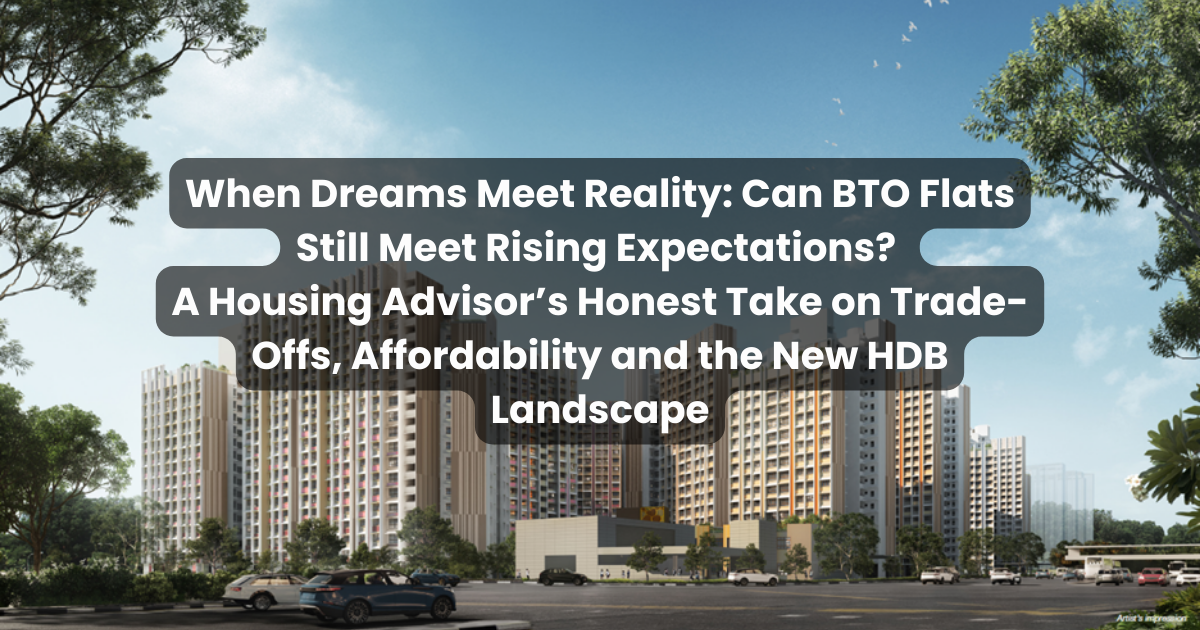
As Channel News Asia posted an article recently, can BTO flats still meet what buyers are hoping for? Fairloan will analyse and advise.
From the perspective of a housing advisor who works closely with young couples, singles and families navigating their first home purchase, the answer is more complicated than it appears. The BTO system remains fundamentally sound, but it is also increasingly shaped by trade-offs, some obvious, some subtle, and some that buyers only recognise years down the road. Understanding these nuances is essential for anyone planning to enter the market today.
The truth is this: buyers are not wrong for wanting a dream home. But the definition of “dream” often conflicts with the constraints of affordability, land scarcity, varying neighbourhood maturity, and government policy goals such as equity and long-term stability. When dreams meet reality, it is the buyers who must make rational, financially healthy decisions, not the other way around.
Why Expectations for BTO Flats Have Risen Dramatically
Young buyers today are more informed, more exposed to polished home renovations, and more influenced by curated online content than any generation before them. Social media platforms are overflowing with “BTO transformation tours”, “minimalist Scandinavian makeovers” and “$20k renovation hacks”, all of which create a sense that a beautiful, central, well-designed flat is not only desirable but achievable.
At the same time, many grew up in well-established estates such as Kovan, Bishan, Toa Payoh or Queenstown, where amenities are dense, transport is seamless and community identity is strong. Comparing these with growth towns like Tengah, Sembawang or Punggol creates an emotional gap, even if the latter offer more affordably priced options.
From an advisor’s perspective, rising expectations are normal; they reflect higher living standards and social mobility. But expectations must be matched with financial realism. Wanting a four-room flat in Redhill for under $450,000 is simply incompatible with market economics.
Singapore’s housing affordability is globally exceptional precisely because HDB prices are discounted from market valuation, but they are not divorced from reality.
And this is where the new Prime and Plus classifications enter the picture.
How the Standard, Plus and Prime System Changed Buyer Psychology
The introduction of the Standard–Plus–Prime system was, at its core, designed to address inequality. Flats in central, highly connected areas were experiencing significant resale windfalls, making it harder for future generations to affordably access prime locations. By tightening the resale conditions and extending the Minimum Occupation Period (MOP) to ten years, HDB aimed to reduce speculative demand.
But the psychological shift has been even more profound.
Prime flats, which include city-fringe estates like Kallang and Bukit Merah, now come with the strictest restrictions. Buyers must not only commit to longer MOPs; they must also pay a subsidy recovery amount when they sell, and resale buyers must meet BTO eligibility conditions, including income ceiling and citizenship rules.
This fundamentally changes the economics of buying such a flat. The days of purchasing a Dawson BTO and reselling it for a million dollars after five years are effectively over.
Plus flats, while less restrictive, still carry meaningful conditions. They offer more flexibility than Prime but still impose a ten-year MOP and eligibility controls.
As a housing advisor, the new system clarifies the trade-offs. Buyers who truly value centrality and accessibility no longer fantasise about quick flips or resale gains; they commit with full knowledge that the flat is meant for long-term residence. Buyers who want optionality, mobility, or faster wealth-building tend to gravitate toward Standard flats or resale HDBs instead.
This segmentation is not a problem; it is a necessary evolution. But many young couples still struggle to reconcile what they emotionally want with what they financially qualify for.
Affordability: The Core Battle Between Head and Heart
For many first-timers, affordability is the most significant constraint. Mortgage Servicing Ratios (MSR is at 30%), CPF usage, renovation budgets, and future family plans must be carefully weighed. Yet when couples first sit down to choose a BTO project, emotion frequently takes the lead.
A couple who grew up in Kovan may feel strongly about staying near both sets of parents. Another pair may insist on a three-bedroom unit to prepare for future children. Others want to minimise commute time to the CBD or want access to neighbourhood amenities that mirror their upbringing.
The problem arises when these emotional desires clash with rising BTO prices. A four-room flat in a Plus location can easily exceed $650,000 before grants, while a Prime location unit can sit above $750,000. These prices are still considered affordable by global standards, especially after subsidies, but they are objectively not cheap.
As an advisor, I often pose three critical questions:
1) What is your true affordability?
2) What lifestyle assumptions are you making?
3) What are you willing to compromise?
These questions reveal how buyers balance head and heart. And more often than not, buyers discover that compromises are not a failure; they are a strategy.
The Trade-Offs Buyers Must Accept in the New Housing Landscape
The tension between desire and constraint underlies every BTO decision. No buyer gets to avoid trade-offs; the question is which ones they are comfortable with.
The most common trade-off lies between location and price. A couple who choose a four-room unit in Yishun may end up paying nearly $300,000 less than if they insisted on a similar unit in Queenstown or Kallang. That alone can mean years less financial stress, faster wealth accumulation, and a more comfortable lifestyle.
Another major trade-off is between flexibility and stability. Prime and Plus flats offer buyers prices well below market valuation, but lock them into long MOP periods. This is suitable for couples who envision long-term stability, but it is not ideal for those who anticipate life changes such as caregiving obligations, overseas work opportunities, or job relocations.
There is also the trade-off between wait time and desire. Some couples insist on applying only for central BTO launches, even if oversubscription means they may try for years without success. Others are open to Standard flats in new towns and frequently secure keys several years earlier.
From the perspective of a housing advisor, the healthiest buyer mindset is one that treats trade-offs as part of a long-term financial strategy, not as a loss of ideals.
Singles: A Growing Force With Unique Constraints
One of the fastest-growing segments in the housing market is singles aged 35 and above. Policy changes now allow them to apply for two-room BTO flats island-wide, and the Family Care Scheme has created greater flexibility for living near parents. However, the supply of small units remains limited, driving intense competition.
Many singles share a consistent frustration: the eligibility age of 35. As an advisor, I understand this sentiment deeply. Many singles are financially capable much earlier, yet must wait due to policy limitations. Until policy reforms fully align with lifestyle trends, singles will continue to face a bottleneck in supply and eligibility.
But singles, perhaps more than couples, must plan housing affordability with utmost prudence. Without dual-income support, reserve funds, CPF adequacy, and job stability, a flat’s long-term sustainability depends more on these factors.
Why Buyers Need Better Advisory, Not Louder Marketing
The BTO process is emotionally charged, financially significant and bureaucratically complex. While HDB has simplified many aspects through the HFE system and clearer classification schemes, buyers still struggle with interpreting their affordability, choosing suitable loan structures, and planning for renovation and recurring costs.
This is where housing advisors fill a crucial gap. A good advisor does not simply calculate loan quantum; they guide buyers through realistic expectations, psychological biases, and long-term financial planning.
For instance, many couples stretch their budgets to secure larger homes, only to find later that renovations, furniture and upcoming life events such as marriage, children, and caregiving can strain their finances more than expected. Advisors help buyers understand how loan obligations intersect with savings goals, investments and career progression.
Similarly, buyers often misunderstand grants, confusing Enhanced CPF Housing Grants with income ceilings or overestimating their impact. Advisors help decode these nuances so buyers avoid pitfalls.
In an era where oversubscription of BTO projects has become the norm, an informed buyer is not just an advantage; it is a necessity.
The Future of BTO Housing: More Choice, But More Complexity
Looking ahead, the future of BTO housing will be defined by greater segmentation, stronger policy safeguards, and rising buyer sophistication. With HDB planning to launch over 55,000 new flats between 2025 and 2027, supply will expand meaningfully. But demand will continue to be shaped by lifestyle aspirations, remote work trends, caregiving needs, and cultural expectations.
Prime locations will remain competitive and tightly controlled. Plus locations will become the new battleground for aspirational young couples. Standard flats will continue to offer exceptional affordability for buyers who prioritise financial prudence.
The system is becoming fairer, but also more complex. Buyers who understand the landscape and who use advisors to interpret it will make the best decisions.
Conclusion: The Dream Home Is Not Found. It Is Designed
In the end, the most profound shift needed is not in HDB policy, but in the buyer mindset. The dream home is rarely the first home. It is the home that balances affordability, comfort, and long-term mobility. A couple who buys a Standard flat, builds equity, and upgrades later may achieve greater financial security than those who overstretch for a Prime unit they cannot comfortably hold.
As a housing advisor, my role is not to tell buyers what to choose, but to illuminate the trade-offs clearly enough that they can make informed choices with confidence. In a landscape where expectations continue to rise and the tension between dreams and reality persists, clarity becomes the most powerful tool a buyer can possess.
Because ultimately, a good home is not defined by postcode or prestige, it is defined by how well it supports the life you intend to build.