Choosing between an HDB loan and a bank loan has always been one of the biggest decisions for homebuyers in Singapore.
But as we enter 2025 and 2026, the landscape has shifted significantly. Interest rates, SORA trends, and government housing policies have all evolved, and buyers are now navigating a market where bank loans can sometimes match or even beat the stability traditionally associated with HDB loans.
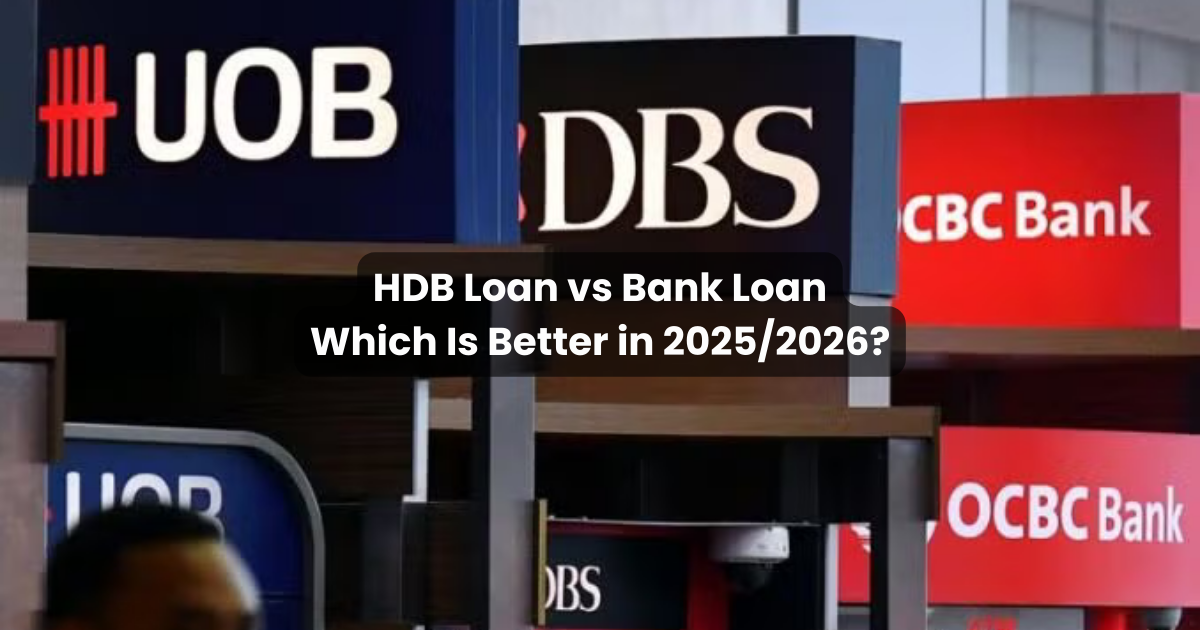
Recent months have seen banks offering some of the lowest fixed packages in years, with several major lenders including DBS, UOB and OCBC, rolling out five-year fixed rates at 1.78%, as well as three-year fixed rates between 1.50% and 1.55%. These rates are highly competitive compared to the long-standing 2.6% HDB concessionary loan, prompting many homeowners to rethink the conventional wisdom of “HDB is always safer.”
Whether you’re applying for a BTO, purchasing a resale flat, or refinancing your existing mortgage, understanding the difference between an HDB loan and a bank loan is crucial. This guide breaks down how the two compare in 2025/2026, not just in interest rates, but in flexibility, risk, eligibility, refinancing options, and long-term costs.
What Is the HDB Loan?
The HDB loan is a government-backed mortgage option available only for HDB flat purchases. It remains popular among first-time buyers because of its stability and flexible terms. The interest rate is pegged at 2.6%, which is 0.1% above the CPF Ordinary Account (OA) interest rate of 2.5%. Historically, this rate has not changed since 1999.
The biggest appeal of the HDB loan is its predictability. Unlike bank loans, it does not fluctuate with market conditions. For buyers with long planning horizons or tight cashflow, this stability is reassuring.
Another advantage is the lower upfront cash requirement. With an HDB loan, buyers can use CPF Ordinary Account funds to cover almost all of the initial payments, minimising cash outlay.
However, the biggest limitation of the HDB loan today is that its interest rate, once considered affordable, is now significantly higher than many bank packages. This has created a dynamic where buyers who value lower monthly instalments or long-term savings may now find bank loans more attractive.
What Are Bank Loans Like in 2025/2026?
Bank loans are offered by financial institutions and come in several forms: fixed-rate packages, floating SORA-based packages, hybrid loans, and fixed deposit-pegged options like DBS FHR6. The interest rates are market-driven and therefore fluctuate over time.
As of late 2025 going into 2026, bank home loan rates have entered one of the most competitive periods in recent memory. This is largely driven by stabilising SORA rates and moderate expectations for future US Federal Reserve cuts.
Here’s what banks are currently offering:
Check out the full rates offered by banks here
1. Five-year fixed packages at around 1.78%
Offered by DBS, UOB and OCBC, these long fixed terms are attractive because they are significantly below HDB’s 2.6% and offer rate stability for half a decade.
2. Three-year fixed packages at 1.50% to 1.55%
These are among the lowest fixed rates we’ve seen in years. Many buyers look at these packages as a “sweet spot”, locking in savings without committing to a long fixed period.
3. Floating 3M SORA packages
Floating rates generally range between 1.5% and 1.8%, depending on the bank’s spread. With SORA expected to hover around 1.3%–1.5% through 2026, floating packages remain competitive.
4. DBS FHR6 (Fixed Deposit Pegged Rates)
These packages move with DBS’s fixed deposit rates. They tend to be more stable than pure floating SORA packages, but the bank retains discretion to adjust the underlying FD rate.
These developments make bank loans more flexible and potentially cheaper than HDB loans under current conditions.
HDB Loan vs Bank Loan: Key Differences in 2025/2026
Although interest rate comparisons often dominate the conversation, the true difference between HDB and bank loans in 2025/2026 lies in a combination of factors:
1. Interest Rates
- HDB Loan: Fixed at 2.6% (no change since 1999)
- Bank Fixed Rates: 1.50%–1.78% (depending on 2 to 5year lock-ins)
- Bank Floating SORA: 1.5%–1.8% average
Verdict:
Bank loans are currently much cheaper, saving borrowers hundreds per month.
2. Cashflow Flexibility
HDB loans have softer payment rules. For example, HDB is more flexible with late payments and financial difficulty arrangements.
Banks are stricter. Missing payments quickly affects credit score and may incur penalties.
Verdict:
HDB loans offer greater cashflow flexibility for households with less stable income.
3. Upfront Downpayment
- HDB Loan: 25% downpayments (all can be CPF)
- Bank Loan: 25% downpayment (at least 5% must be cash)
Verdict:
This makes HDB loans easier for buyers who prefer to conserve cash.
4. Ability to Refinance
Borrowers with bank loans can refinance when rates drop. This is a major advantage especially in a rate environment like 2025/2026.
But do note that clients are unable to switch back HDB loan (2.6%) once they are with Bank Loans.
Verdict:
Bank loans offer long-term savings potential, especially when refinancing cycles are favourable.
5. Stability vs Market Sensitivity
HDB loan:
- Highly stable
- No changes for 25+ years
Bank loans:
- Fixed periods eventually expire
- Floating rates fluctuate
- Banks can revise spreads
Verdict:
HDB gives stability; banks give risk and reward.
Who Should Choose an HDB Loan in 2025/2026?
Despite bank loans offering lower rates, the HDB loan remains the right choice for certain buyers.
You may prefer an HDB loan if:
- Your income is volatile (commission-based, self-employed, gig work)
- You have tighter monthly cashflow
- You want minimal risk of rate changes
- You want higher CPF utilisation and lower cash commitment
- You value long-term payment stability more than savings
The key advantage of the HDB loan is not its rate, it is its forgiveness and flexibility.
Buyers who prioritise peace of mind often choose HDB loans even in low-rate banking environments.
Who Should Choose a Bank Loan in 2025/2026?
With bank rates sitting far below the HDB 2.6% rate, most financially stable buyers will benefit from a bank loan.
A bank loan is likely better if:
- You have stable income
- You want to lower monthly instalments
- You are comfortable monitoring interest rates
- You plan to refinance regularly
- You are aiming for long-term savings
In 2025 heading to 2026, fixed packages at 1.5%–1.78% are exceptionally attractive, these rates effectively lock in savings of thousands per year compared to HDB’s fixed 2.6%.
So, Which Is Better in 2025/2026?
With current rates:
- Bank loans offer the lowest interest costs
- HDB loans offer the most payment flexibility
For most buyers in 2025/2026, bank loans will provide better financial outcomes, especially with fixed packages at historic lows and floating SORA stabilising.
However, buyers with cashflow uncertainty or risk aversion may still prefer HDB loans for peace of mind.
If rates rise again in future (as they did in 2022–2023), borrowers on bank loans can refinance, a powerful advantage. Borrowers on HDB loans cannot switch back after converting to a bank loan.
Fairloan’s Recommendation
Based on current 2025/2026 home loan conditions:
- Risk-averse buyers: Choose a 2 or 3-year fixed rate, around 1.50%–1.55%
- Buyers wanting long-term security: Choose a 5-year fixed at 1.78%
- Buyers expecting further small rate drops: Choose floating SORA
- Clients wanting the best of both worlds: Choose hybrid loans with free conversion options
The key is not just choosing the lowest rate, but choosing the right structure based on your income stability, financial goals, and risk profile.
Fairloan can help you compare DBS, UOB, OCBC, HSBC, Maybank, CIMB and more across all fixed, floating, hybrid and SORA-based packages. We provide unbiased recommendations based on your affordability, cashflow and long-term plans.
Do check out whats the latest rates offered by Banks here